
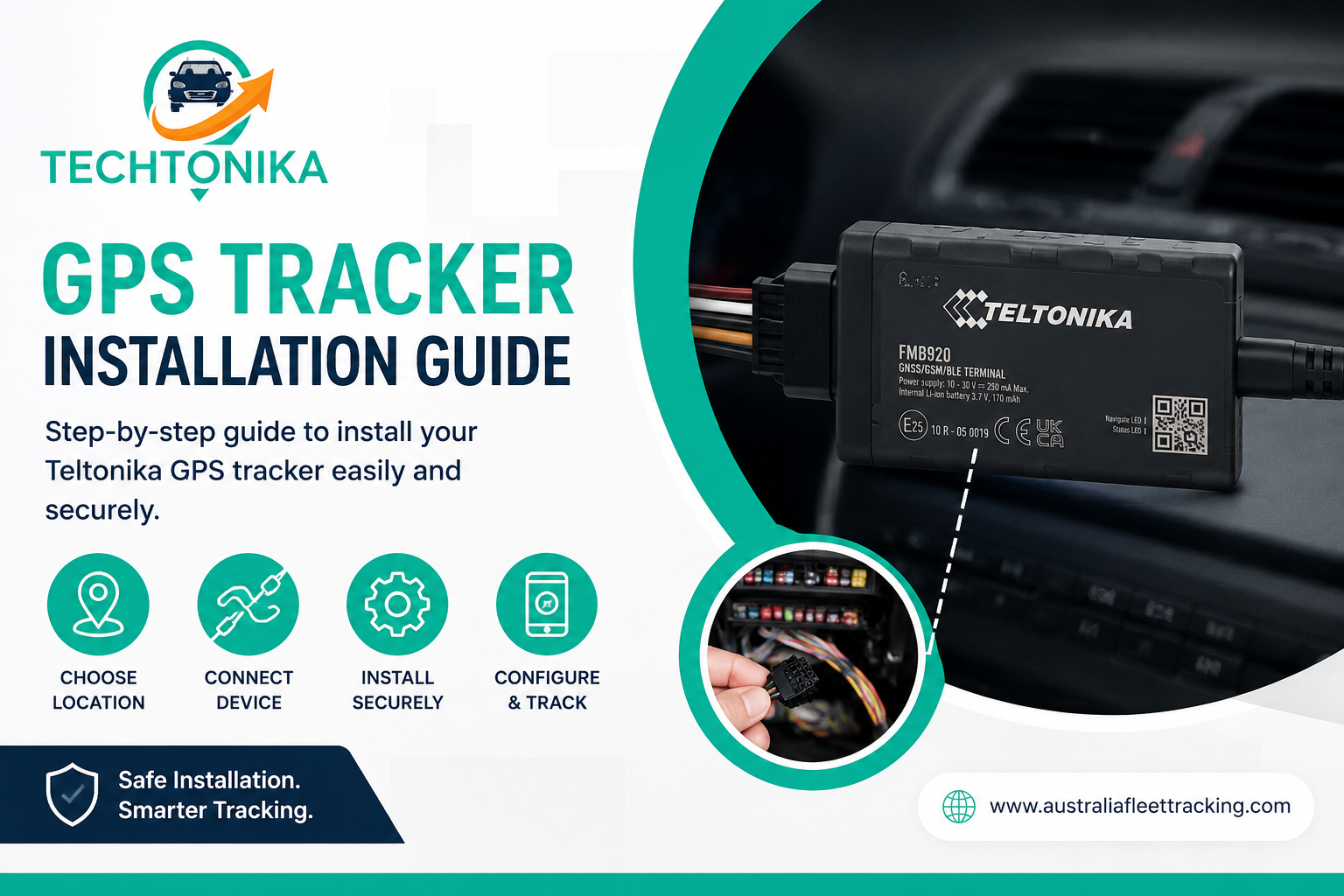
A successful GPS tracker installation guide stable power, accurate ignition status, reliable satellite and mobile reception, safe mechanical mounting and verified platform data. Installation is not complete when the LED turns on; it is complete when the vehicle has been driven and every required event has been tested.
This guide is written for vehicle owners, fleet administrators and installers planning a safe, reliable deployment. It explains the decision in an Australian context, including the completed 3G shutdown, current mobile connectivity, realistic technical limitations, installation quality, privacy and the ongoing service behind the hardware.
The core decision – GPS tracker installation guide
Start by defining the outcome in one sentence. Examples include receiving an alert when a parked car moves, seeing which technician is closest to a job, reconstructing a route after an incident or locating a trailer that has no permanent power. The sentence should identify the asset, event, acceptable delay and responsible person.
Next, identify constraints: available power, operating environment, mobile coverage, concealment, installation time, required data retention and budget. These constraints eliminate unsuitable device types before minor features are compared.
At-a-glance comparison
| Check | Pass condition | If it fails |
| Power | Stable voltage and correct sleep behaviour | Review circuit, earth and configuration |
| GNSS | Reliable fix in final mounting position | Reposition away from shielding/interference |
| Mobile | Uploads on intended network | Check SIM, bands, coverage and APN |
| Ignition | Starts and ends trips correctly | Review input or voltage logic |
| Alerts | Correct recipient and useful timing | Adjust rule, threshold and notification |
| Vehicle assignment | IMEI matches registration/asset | Correct platform record before handover |
Plan the installation
Confirm the exact device, vehicle, voltage, required inputs and desired alerts.
For vehicle owners, fleet administrators and installers planning a safe, reliable deployment, this is important because the specification on a product page only becomes useful when it is connected to a real operating condition. Consider the normal day, the worst credible event and the person expected to respond. That approach turns a feature into a requirement that can be tested.
Record the IMEI or serial number and allocate the tracker to the correct vehicle in the platform.
The practical test is repeatability. Confirm the behaviour in the final vehicle or asset, using the intended network and platform settings. A short controlled trial often exposes power, placement, coverage or notification problems that are invisible during a desk review.
Decide whether the job is simple OBD, portable placement or permanent hardwiring.
Document the chosen setting and the reason for it. This makes future support easier, prevents accidental configuration changes and helps another administrator understand whether the system is operating as designed.
Choose a safe location
The device needs a reasonable radio path and should not be enclosed behind heavy metal.
For vehicle owners, fleet administrators and installers planning a safe, reliable deployment, this is important because the specification on a product page only becomes useful when it is connected to a real operating condition. Consider the normal day, the worst credible event and the person expected to respond. That approach turns a feature into a requirement that can be tested.
Keep it dry, mechanically secure and away from pedals, steering, airbags, hot components and moving parts.
The practical test is repeatability. Confirm the behaviour in the final vehicle or asset, using the intended network and platform settings. A short controlled trial often exposes power, placement, coverage or notification problems that are invisible during a desk review.
The location should be concealed when security matters but accessible to authorised technicians.
Document the chosen setting and the reason for it. This makes future support easier, prevents accidental configuration changes and helps another administrator understand whether the system is operating as designed.
Hardwired power and ignition
Permanent power, earth and ignition detection must use suitable vehicle circuits and protection.
For vehicle owners, fleet administrators and installers planning a safe, reliable deployment, this is important because the specification on a product page only becomes useful when it is connected to a real operating condition. Consider the normal day, the worst credible event and the person expected to respond. That approach turns a feature into a requirement that can be tested.
Connections should be secure, insulated and strain-relieved. The tracker voltage range must match the vehicle.
The practical test is repeatability. Confirm the behaviour in the final vehicle or asset, using the intended network and platform settings. A short controlled trial often exposes power, placement, coverage or notification problems that are invisible during a desk review.
Modern vehicles have sensitive electronics and sleep systems; competent vehicle-specific installation is recommended.
Document the chosen setting and the reason for it. This makes future support easier, prevents accidental configuration changes and helps another administrator understand whether the system is operating as designed.
OBD installation
Inspect the port for damage and confirm the device will not obstruct the driver or trim.
For vehicle owners, fleet administrators and installers planning a safe, reliable deployment, this is important because the specification on a product page only becomes useful when it is connected to a real operating condition. Consider the normal day, the worst credible event and the person expected to respond. That approach turns a feature into a requirement that can be tested.
Plug the unit fully into place, then check power, GNSS and network status in the app.
The practical test is repeatability. Confirm the behaviour in the final vehicle or asset, using the intended network and platform settings. A short controlled trial often exposes power, placement, coverage or notification problems that are invisible during a desk review.
If relocation is needed, use an appropriate secured extension without creating loose wiring near the driver.
Document the chosen setting and the reason for it. This makes future support easier, prevents accidental configuration changes and helps another administrator understand whether the system is operating as designed.
Battery and magnetic placement
Charge the unit, configure sleep and reporting, and assign a low-battery alert.
For vehicle owners, fleet administrators and installers planning a safe, reliable deployment, this is important because the specification on a product page only becomes useful when it is connected to a real operating condition. Consider the normal day, the worst credible event and the person expected to respond. That approach turns a feature into a requirement that can be tested.
Use a mount appropriate to the device rating and environment. Strong magnets do not eliminate impact or detachment risk.
The practical test is repeatability. Confirm the behaviour in the final vehicle or asset, using the intended network and platform settings. A short controlled trial often exposes power, placement, coverage or notification problems that are invisible during a desk review.
Never place a unit where it could contact hot, moving or safety-critical systems.
Document the chosen setting and the reason for it. This makes future support easier, prevents accidental configuration changes and helps another administrator understand whether the system is operating as designed.
Inputs, sensors and immobilisation
Test each door, panic button, temperature sensor or other input separately and label it correctly in the platform.
For vehicle owners, fleet administrators and installers planning a safe, reliable deployment, this is important because the specification on a product page only becomes useful when it is connected to a real operating condition. Consider the normal day, the worst credible event and the person expected to respond. That approach turns a feature into a requirement that can be tested.
Outputs must use suitable relays and protection. Remote immobilisation needs a safe design that prevents hazardous operation.
The practical test is repeatability. Confirm the behaviour in the final vehicle or asset, using the intended network and platform settings. A short controlled trial often exposes power, placement, coverage or notification problems that are invisible during a desk review.
Document the wiring for authorised maintenance without exposing it publicly.
Document the chosen setting and the reason for it. This makes future support easier, prevents accidental configuration changes and helps another administrator understand whether the system is operating as designed.
Commissioning and handover
Drive a representative route and review ignition, trip start, route, speed, stops and trip end.
For vehicle owners, fleet administrators and installers planning a safe, reliable deployment, this is important because the specification on a product page only becomes useful when it is connected to a real operating condition. Consider the normal day, the worst credible event and the person expected to respond. That approach turns a feature into a requirement that can be tested.
Test movement, geofence, power-loss and low-battery alerts as applicable.
The practical test is repeatability. Confirm the behaviour in the final vehicle or asset, using the intended network and platform settings. A short controlled trial often exposes power, placement, coverage or notification problems that are invisible during a desk review.
Provide user access, training, privacy notices, support contacts and an installation record.
Document the chosen setting and the reason for it. This makes future support easier, prevents accidental configuration changes and helps another administrator understand whether the system is operating as designed.
A practical selection process
Step 1: Confirm scope and vehicle compatibility.
Write down the evidence needed to confirm this step. Use an actual vehicle, asset, user account and notification channel wherever possible. Record the result so installation and support teams work from the same information.
Step 2: Activate SIM and platform record.
Write down the evidence needed to confirm this step. Use an actual vehicle, asset, user account and notification channel wherever possible. Record the result so installation and support teams work from the same information.
Step 3: Select safe placement and power method.
Write down the evidence needed to confirm this step. Use an actual vehicle, asset, user account and notification channel wherever possible. Record the result so installation and support teams work from the same information.
Step 4: Complete secure installation.
Write down the evidence needed to confirm this step. Use an actual vehicle, asset, user account and notification channel wherever possible. Record the result so installation and support teams work from the same information.
Step 5: Validate LEDs and platform status.
Write down the evidence needed to confirm this step. Use an actual vehicle, asset, user account and notification channel wherever possible. Record the result so installation and support teams work from the same information.
Step 6: Drive-test and trigger required alerts.
Write down the evidence needed to confirm this step. Use an actual vehicle, asset, user account and notification channel wherever possible. Record the result so installation and support teams work from the same information.
Step 7: Document and hand over the system.
Write down the evidence needed to confirm this step. Use an actual vehicle, asset, user account and notification channel wherever possible. Record the result so installation and support teams work from the same information.
Australian network considerations in 2026
Australia’s 3G network shutdown was completed in 2024. New deployments should use a compatible 4G technology and service. Confirm the exact modem bands, carrier arrangement and coverage rather than relying on a broad 4G description. LTE Cat 1, LTE-M and NB-IoT have different characteristics and are not automatically interchangeable.
ACMA introduced standardised mobile coverage information in 2026, which helps buyers compare published coverage categories. Coverage maps remain predictive: terrain, buildings, antennas, network load and installation affect real performance. For regional operation, test representative routes and verify offline record storage and later upload.
Platform, data and support checklist
- Live map and mobile access are clear for everyday users.
- Trip history includes reliable timestamps and useful playback.
- Alerts can be configured by vehicle, time and recipient.
- User roles restrict access to appropriate vehicles and functions.
- Data retention and export meet operational needs.
- The provider supports the device, SIM, platform and installation pathway.
- Passwords, user removal and access reviews are part of normal administration.
Common mistakes
- Testing on the bench but not in the final location.
- Using an unsuitable circuit or poor earth.
- Mounting near airbags, pedals or heat.
- Leaving loose OBD extensions in the footwell.
- Skipping power-loss and offline-reconnection tests.
- Enabling immobilisation without a safe design.
Most mistakes are prevented by a short trial, written acceptance criteria and a commissioning checklist. Avoid changing several settings at once during troubleshooting; isolate power, GNSS, mobile connectivity, device logic and platform behaviour in that order.
Costs and value
Compare total cost over the expected ownership period. Include hardware, SIM and mobile data, platform subscription, installation, accessories, support, warranty, replacement and internal administration. An inexpensive unit can become costly if it loses data, requires frequent charging or has no accountable support path.
Value should be tied to the objective. For security, measure alert speed and response readiness. For fleets, measure avoided kilometres, dispatch time, utilisation, verified attendance, maintenance administration or reduced unauthorised use. Do not collect data simply because the device can produce it.
Privacy, workplace use and responsible tracking
Tracking must have a legitimate purpose and lawful authority. Australian surveillance, privacy and workplace requirements vary by jurisdiction and circumstance. The OAIC advises employers to comply with relevant Commonwealth, state and territory laws. NSW’s Workplace Surveillance Act expressly addresses tracking surveillance and contains notice and other requirements.
Businesses should explain what is collected, when tracking occurs, why it is needed, who can access it and how long it is retained. Use permissions, audit access and remove former users promptly. Obtain legal advice for the actual operation, especially for covert surveillance, employee disputes or tracking involving another person. This article is general information, not legal advice.
Why choose Australia Fleet Tracking
Australia Fleet Tracking supplies GPS tracking and telematics solutions for cars, commercial fleets, trucks and assets. The range includes hardwired, OBD, battery-powered and advanced Teltonika devices, supported by tracking software and professional installation options.
For advice, visit https://australiafleettracking.com/, call 0452 653 745 or email Pankaj@techtonika-autolink.com. A short requirements discussion can identify the suitable device, connectivity, installation and platform settings before purchase.
Frequently asked questions
Where should a tracker be installed?
In a dry, secure and radio-friendly location that does not interfere with vehicle safety systems.
Confirm the final answer against the selected device, service plan, vehicle and operating location, because configuration and compatibility can change the practical result.
Can I install one myself?
Portable and OBD products are usually simple. Permanent wiring and immobilisation require appropriate competence.
Confirm the final answer against the selected device, service plan, vehicle and operating location, because configuration and compatibility can change the practical result.
Does the antenna need to face up?
Follow the model guidance. Integrated antenna orientation and surrounding materials affect performance.
Confirm the final answer against the selected device, service plan, vehicle and operating location, because configuration and compatibility can change the practical result.
Which fuse should be used?
Circuit selection and protection are vehicle-specific. Use the manufacturer instructions and competent automotive electrical practice.
Confirm the final answer against the selected device, service plan, vehicle and operating location, because configuration and compatibility can change the practical result.
How long does installation take?
It varies from minutes for OBD to longer for concealed hardwiring, sensors and commissioning.
Confirm the final answer against the selected device, service plan, vehicle and operating location, because configuration and compatibility can change the practical result.
Why is ignition status wrong?
The input, voltage threshold, sleep logic or platform configuration may be incorrect.
Confirm the final answer against the selected device, service plan, vehicle and operating location, because configuration and compatibility can change the practical result.
Should wires be soldered?
Use approved automotive connection practices appropriate to the vehicle and environment; workmanship and strain relief are critical.
Confirm the final answer against the selected device, service plan, vehicle and operating location, because configuration and compatibility can change the practical result.
How do I test coverage?
Drive normal routes, review timestamps and test reconnection after a controlled coverage gap where practical.
Confirm the final answer against the selected device, service plan, vehicle and operating location, because configuration and compatibility can change the practical result.
Can it be installed near the radio?
Avoid sources of interference and verify performance in the final position.
Confirm the final answer against the selected device, service plan, vehicle and operating location, because configuration and compatibility can change the practical result.
What records should fleets keep?
Device ID, vehicle, date, installer, location, wiring/features, configuration, test results and authorised users.
Confirm the final answer against the selected device, service plan, vehicle and operating location, because configuration and compatibility can change the practical result.
Final takeaway
A successful GPS tracker installation provides stable power, accurate ignition status, reliable satellite and mobile reception, safe mechanical mounting and verified platform data. Installation is not complete when the LED turns on; it is complete when the vehicle has been driven and every required event has been tested.
Choose using evidence: current Australian network compatibility, appropriate power, safe placement, useful software, tested alerts and support that covers the complete system. Then commission it in the real asset and document the configuration.
Sources and editorial references
- Australian Communications and Media Authority, 3G network switch off: https://www.acma.gov.au/3g-network-switch
- Australian Communications and Media Authority, mobile coverage transparency rules (2026): https://www.acma.gov.au/articles/2026-06/new-telco-transparency-rules-now-force
- Geoscience Australia, Positioning and navigation: https://www.ga.gov.au/scientific-topics/positioning-navigation
- Office of the Australian Information Commissioner, Workplace monitoring and surveillance: https://www.oaic.gov.au/privacy/your-privacy-rights/surveillance-and-monitoring/workplace-monitoring-and-surveillance
- NSW Legislation, Workplace Surveillance Act 2005: https://legislation.nsw.gov.au/view/html/inforce/current/act-2005-047/lh
- Australia Fleet Tracking: https://australiafleettracking.com/
Techtonika Autolink
Follow Us
Facebook: https://www.facebook.com/profile.php?id=61591321884124
Instagram: https://www.instagram.com/techtonikaautolink/
LinkedIn: https://au.linkedin.com/company/techtonika-autolink
Unit 507, 15 Chatham Rd West, Ryde NSW 2114


