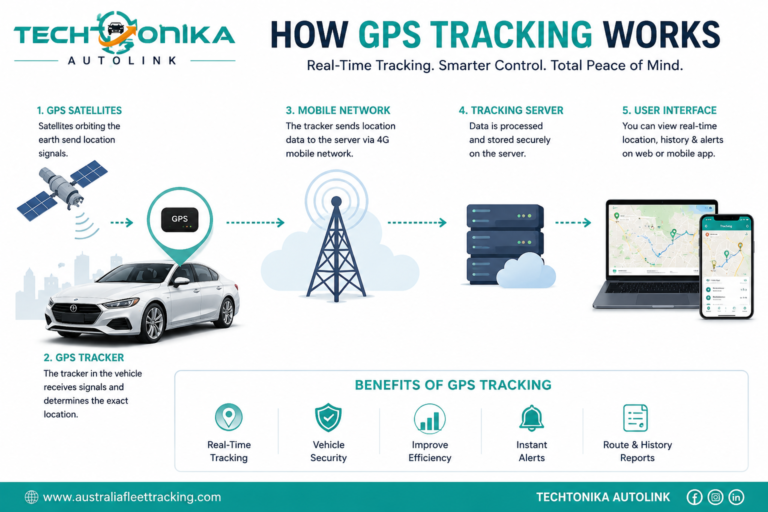

Traffic-control businesses move crews, vehicles, signs, barriers and arrow boards between changing worksites. Tracking can support allocation and asset control, but it never replaces the approved traffic management plan or safe system of work.
Why traffic control companies needs more than a dot on a map
Working on or next to a public road exposes workers to moving vehicles, changing conditions and limited escape space. Safe Work Australia classifies such work as high-risk construction work requiring a SWMS where applicable.
A fleet platform can show whether vehicles and mobile assets reached a job area, help find arrow boards or trailers and support after-hours movement alerts. It cannot determine whether signs were installed correctly, traffic controllers were positioned safely or the plan matched conditions.
Schedules and dispatch targets must not create pressure to speed, skip setup checks or work fatigued. Tracking should help identify unrealistic travel and mobilisation assumptions.
| Use data for decisions: Use the platform to support logistics and evidence—not to certify temporary traffic management. |
Define the operating questions first
Translate the business case into questions that dispatch, supervisors, workshops and safety staff can answer. For traffic control companies, the nearest vehicle is useful only when it also has the right crew, equipment and status.
Define an exception precisely and assign a response. Unowned alerts become noise; vague thresholds create disputes and encourage managers to draw conclusions from incomplete data.
- Which qualified crew and vehicle is assigned?
- Are the required signs, boards and trailers available?
- Did assets reach the job staging area?
- Has equipment moved outside the approved window?
- Which vehicles face unrealistic travel between shifts?
- Can return-to-depot and maintenance be verified?
Match the tracker and installation to the asset
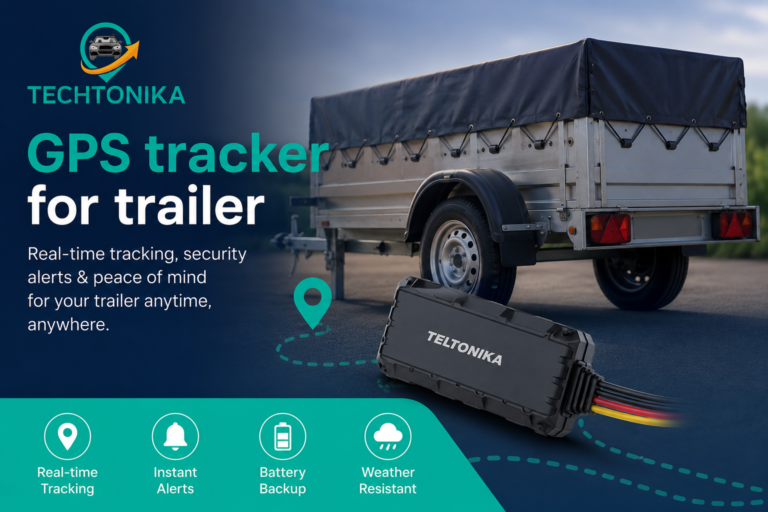
Hardwired vehicle trackers suit traffic-control utes and trucks, while rugged battery units can protect arrow boards, message signs and trailers.
External mounting must consider theft, water, impact, metal obstruction and servicing. Test GPS and mobile performance in transport and deployed positions.
Document device ID, SIM/service, vehicle or asset identity, installer, power source, firmware and acceptance test. Reconcile the register whenever hardware is replaced or an asset changes teams.
| Asset or workflow | Recommended approach | Key control |
| Traffic-control ute/truck | Concealed hardwired tracker | Ignition, driver assignment and after-hours rules |
| Arrow board/message sign | Rugged battery or powered asset tracker | Deployment mode and battery maintenance |
| Sign/barrier trailer | Battery tracker with tow alerts | Correct trailer/job assignment |
Mobilise crews and assets without weakening safety
Dispatch should confirm the approved work pack, crew competence, vehicle and asset list before using proximity. A closer crew may not hold the required authority or equipment.
Job-site geofences should include staging and safe parking areas. Presence does not confirm that the traffic setup is correct; supervisors must follow inspections and sign-off procedures.
After demobilisation, reconcile every trailer, board and device to the depot or next job. Unclosed assignments cause both missing assets and misleading customer records.
- Confirm approved plan, permit and work pack.
- Assign competent crew, vehicle and asset kit.
- Check travel and fatigue constraints.
- Verify staging-area arrival.
- Complete independent setup inspections.
- Demobilise and reconcile assets.
Safety, privacy and governance boundaries
Vehicle location can become personal information when a worker, customer or service recipient is identifiable. Collect only what is reasonably necessary, provide appropriate notices, restrict access and retain records for a defined purpose.
Keep SWMS, approved traffic guidance, permits, inspections and incident processes authoritative. Location data about workers requires notice and controlled access; sensitive roadwork and critical-infrastructure locations may also require security restrictions.
Tracking is supporting evidence. It does not prove every task, safety outcome, attendance claim or legal obligation. Review timestamps, device health and corroborating records before high-impact decisions.
- Use role-based access and multi-factor authentication.
- Show last-update time wherever location appears.
- Control exports and remove former users promptly.
- Document the correction and dispute process.
- Review legal requirements in each operating jurisdiction.
Reports and measures that lead to action
Choose measures that connect to decisions in traffic control companies: response time, completed work, utilisation, maintenance, exceptions and device health. Define each measure before comparing teams.
Use trends to ask better questions. Location data lacks context about job complexity, weather, access, customer needs and safe work choices; do not turn a single derived number into an automatic performance verdict.
| Measure | What it can show | What it cannot prove |
| Job geofence | Vehicle or asset entered the work area | Correct setup or compliance with the plan |
| After-hours movement | Asset moved outside a rule | Theft or unauthorised use without verification |
| Travel time | Movement between depot and site | Safe scheduling or worker fitness by itself |
A practical 90-day rollout
Pilot the hardest operating cases, not only the newest vehicle near the office. Include weak coverage, covered parking, auxiliary power, long stops and the actual reports managers intend to rely on.
At day 90, reconcile the register, investigate every unknown device, compare outcomes with the baseline and delete alerts or data fields that have no defined action.
- Days 1–15: document the traffic control companies fleet, operating risks, users, legal requirements and current baseline.
- Days 16–30: pilot representative vehicles and assets, including the hardest coverage, power or environmental case.
- Days 31–45: test location timestamps, trip rules, power events, alerts, reports, user permissions and exports.
- 10.Days 46–60: issue notices and policies, train managers and workers, and assign an owner to every alert.
- 11.Days 61–75: deploy in controlled waves, reconcile every device to the correct asset and close installation defects.
- 12.Days 76–90: compare results with the baseline, remove noisy alerts and document the next improvement cycle.
Example: an arrow board is missing after demobilisation
The depot count identifies a missing arrow board. The platform shows a fresh position at the previous staging area and no subsequent tow movement.
A supervisor verifies the device and job assignment, contacts the site controller and arranges safe collection under the required road-access process. Staff do not enter the roadway simply because a map shows the asset.
The close-out checklist is updated so the next job cannot be marked complete until all assigned assets are reconciled.
Questions to ask a GPS tracking provider
Ask for a demonstration using a realistic day rather than a polished map alone. The supplier should be able to show a stale last-known point, a mobile-coverage gap, a device-power event, a corrected asset assignment and a report export. Those details determine whether managers can trust the system during an exception.
Price comparisons should include hardware, installation, connectivity, platform access, accessories, support, replacements, data retention and exit costs. The cheapest device can become expensive when it creates false alerts, requires frequent visits or cannot support the workflow that justified the project.
- Which Australian mobile networks and radio technologies does the service use, and how are coverage gaps displayed?
- What is the normal update interval, history-retention period and process for exporting records?
- Which device, SIM, firmware, vehicle and user changes appear in an audit log?
- What are the hardware warranty, subscription inclusions, replacement process and support hours?
- Can access be limited by role, depot, contract, vehicle group and report type?
- How are installations documented, tested and transferred when a vehicle or asset is replaced?
- Which integrations are genuinely supported for traffic control companies, and who owns failures between systems?
Frequently asked questions
Can GPS confirm a traffic management setup was compliant?
No. It can show vehicle or asset presence, not correct placement, inspection or compliance with the approved plan.
What tracker suits an arrow board?
A rugged battery or powered asset tracker chosen around deployment mode, weather, reporting and maintenance.
Can a geofence replace site sign-off?
No. Use the required inspection and sign-off process.
Does GPS replace a SWMS?
No. Working on or near a public road is high-risk construction work in relevant circumstances, and required safety documentation remains essential.
How can tracking improve traffic-control scheduling?
It can reveal travel, staging, asset availability and recurring delays, helping planners build more realistic mobilisation windows.
About Australia Fleet Tracking
Australia Fleet Tracking helps Australian traffic control companies choose, install and configure Teltonika-based GPS tracking for vehicles and mobile assets. For practical advice on hardware, professional installation and platform setup, visit https://australiafleettracking.com/ or call 0452 653 745.