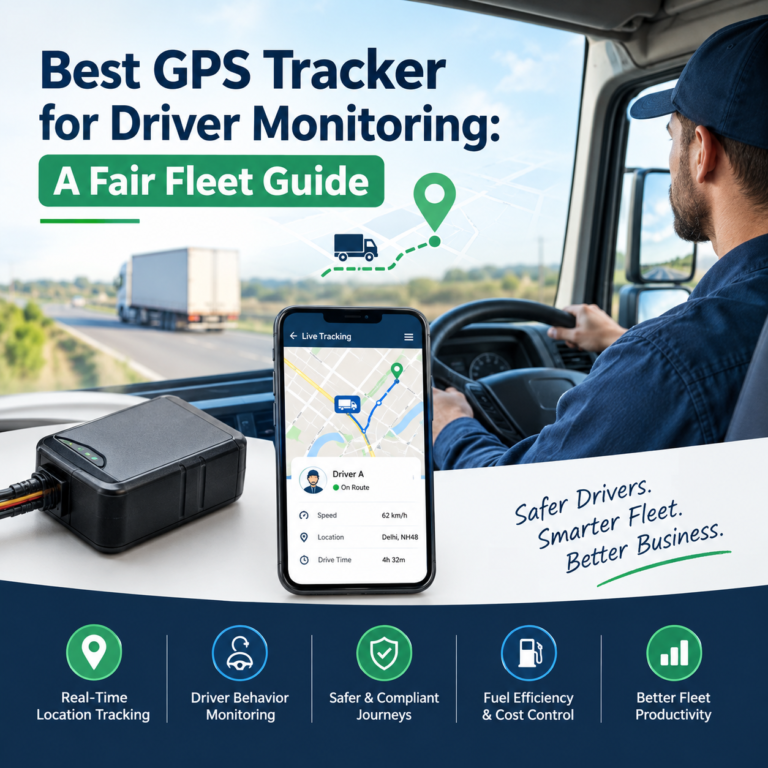

Fatigue Management and GPS Tracking After the 2026 Unfit to Drive Reform
GPS can help identify vehicle movement, timing, route and repeated scheduling patterns, but it cannot diagnose fatigue or confirm that a driver is fit. From 1 August 2026, the HVNL duty extends beyond fatigue to broader fitness factors and applies to all drivers of heavy vehicles over 4.5 tonnes. Operators need reporting, scheduling, training and a safe stop-work process—not only alerts.
Quick decision
Begin with the operational decision, the evidence needed and the person responsible for acting. Select hardware and software only after those three items are clear. Validate every important field against the real vehicle, asset or compliance process before relying on it for a safety, customer, employment or recovery decision.
What changed on 1 August 2026
The Unfit to Drive duty expands the earlier focus on fatigue. A driver must not drive a heavy vehicle on a road while impaired by fatigue or unfit to drive. Fitness may be affected by illness, injury, medication, stress, mental illness, alcohol, drugs or other factors. The broader duty applies beyond fatigue-regulated heavy vehicles.
- Update policies to current-law wording.
- Cover all heavy-vehicle drivers in the fitness process.
- Train managers and schedulers on the right to stop.
What GPS can show
A properly configured tracker can provide vehicle movement, ignition, location, stop duration, trip history and sometimes driver identification or vehicle data. These records may help review work patterns and schedule pressure. They remain vehicle-system records and must be checked for assignment, outages and configuration.
- Verify the assigned driver.
- Check time zones and missing-data periods.
- Use patterns, not isolated dots, for review.
What GPS cannot show
No map can determine whether a person slept, was ill, had a medication effect or was psychologically fit. A parked truck is not proof of restorative rest. Avoid platform labels that overstate conclusions. Describe events as vehicle activity or configured risk indicators until reviewed with other evidence.
- Never auto-declare a driver fatigued from one event.
- Do not use inactivity as confirmed rest.
- Provide a human review and challenge process.
Build a fit-for-duty conversation
Drivers need a confidential way to report that they cannot safely continue. Supervisors should know how to remove pressure, arrange a safe alternative and record the operational decision without demanding unnecessary medical detail. The process should also protect a driver from retaliation for a genuine safety report.
- Set a 24-hour escalation contact.
- Plan safe parking and alternative transport.
- Separate health information from routine fleet access.
Schedule design is a control
Repeated speeding, compressed travel times or late arrivals can indicate that work planning is creating risk. Review loading delays, customer windows, route conditions and required breaks. Coaching a driver without correcting an impossible schedule leaves the underlying control failure in place.
- Compare planned and actual travel time.
- Record reasons for urgent changes.
- Escalate recurring customer pressure.
Use alerts carefully
Immediate alerts should be limited to events requiring a prompt safety response. Lower-level patterns belong in periodic review. Tune thresholds by vehicle class and road context, and confirm the tracker is working before relying on an absence of events. Alert fatigue can hide the genuinely important signal.
- Document thresholds and recipients.
- Test delivery after platform changes.
- Review false positives and missed events.
EWD, work diary and GPS distinctions
An approved EWD records work and rest information for regulatory purposes. A written work diary is another recognised record. GPS trip data may support a review but is not automatically an EWD and should not be substituted for required records. Integrations should preserve each system’s role and data lineage.
- Confirm the EWD is currently approved.
- Train drivers on edits and annotations.
- Keep GPS as supporting evidence where appropriate.
Investigate trends fairly
Combine trip data, schedules, driver feedback, vehicle assignment and incident information. Look for recurrence and systemic causes. Document what was concluded and what remains uncertain. Use coaching, schedule redesign and health pathways before defaulting to discipline.
- Give the driver a chance to explain.
- Correct data before using it.
- Track whether the intervention reduced recurrence.
Decision table
| Signal | What it may indicate | What it does not prove |
|---|---|---|
| Long vehicle activity window | Workload or scheduling concern | Exact legal work time |
| Repeated speeding | Time pressure or unsafe behaviour | Driver motive or limiter compliance |
| Long stop | Vehicle stationary | Rest or fitness |
| No reported events | Low activity or missing data | Safe operation |
Implementation plan
1. Define scope
List the vehicles, assets, users, decisions and exclusions. Confirm who owns installation, platform administration, incident response and editorial fact-checking.
2. Create a baseline
Capture current process time, exceptions, costs and data quality before changing the system. Use representative vehicles rather than only the easiest units.
3. Pilot and verify
Install a small group, test coverage and device health, compare platform records with trusted evidence and document configuration. Treat the first weeks as validation, not proof of performance.
4. Train and communicate
Explain the purpose, limits, response procedure, privacy controls and escalation. Give users a way to question incorrect assignments, gaps or alerts.
5. Measure and review
Track whether reports produced timely actions and whether the underlying problem improved. Review access, retention, device status and settings at least quarterly.
Common mistakes to avoid
- Treating a location or alert as proof without checking assignment, time, device health and context.
- Using one hardware or alert configuration for every vehicle and asset.
- Giving broad administrator access or exporting sensitive records into uncontrolled spreadsheets and email.
- Promising guaranteed recovery, savings, compliance or accuracy.
- Failing to update the article after legislation, network support, firmware or product lifecycle changes.
Worked implementation example
Consider an Australian operator evaluating fatigue management GPS tracking across a mixed group of vehicles. The business begins by documenting the current problem and selecting a small pilot that includes different vehicle types, routes and working patterns. It records the existing process, the decisions currently made without reliable data, and the consequences of getting those decisions wrong. This avoids judging the project only by whether a map looks impressive on the first day.
During the first week, the project team focuses on what changed on 1 august 2026. It checks every device assignment against registration details and confirms the timestamp, power state and reporting behaviour. Staff compare platform records with a trusted source such as the vehicle, booking record, work diary, installation sheet or manager log. Differences are recorded as configuration or process issues; they are not hidden to make the pilot look successful.
The second week examines what gps can show. Managers follow the proposed response process with real but low-risk examples. They record who received the alert or report, what other information was checked, how long the decision took and whether the action solved the problem. Where people disagree with a record, the team reviews the device status and operational context before reaching a conclusion.
In week three, the business stress-tests what gps cannot show and build a fit-for-duty conversation. It tests an outage, a device removal or another relevant exception and confirms what users can see. It also reviews permissions and exported files. The goal is not to prove that nothing can fail; it is to make failure visible and ensure the business has a safe fallback when live data is unavailable or uncertain.
At the end of 30 days, the operator compares the agreed baseline with the pilot results and separates three categories: verified improvement, capacity released for other work, and risk controls strengthened. It rejects savings that cannot be traced to actual records. The final decision records the approved hardware, configuration, access roles, response procedure, training and next review date. Expansion occurs only after the pilot evidence is strong enough for the business decision involved.
90-day management cycle
Days 1–15 — establish control
Confirm installation, vehicle assignment, user access, alert delivery and source-data accuracy. Resolve missing or duplicate records before using the information for performance, safety, compliance or customer decisions.
Days 16–30 — calibrate the workflow
Review false positives, reporting delays and unclear responsibilities. Adjust thresholds through a controlled change record. Speak with the people who receive alerts and the drivers or operators affected by them.
Days 31–60 — measure outcomes
Compare the same measures used in the baseline. Note changes in workload, routes, customers, fuel price, staffing or vehicle mix so they are not incorrectly credited to the tracking system.
Days 61–90 — govern and scale
Audit a sample from event to closure, review access and retention, confirm support arrangements and decide which additional vehicles or use cases are ready. Retire reports that do not support an action.
Evidence to retain
- Approved business case and scope
- Vehicle/device assignment register
- Installation and commissioning record
- Configuration and threshold register
- Driver/customer notice where applicable
- Training attendance and instructions
- Device health and outage records
- Alert investigation and closure evidence
- Access reviews and disclosure logs
- Quarterly review decisions and article fact-check date
Questions to ask a provider
- Which exact device and regional order code are proposed?
- Which Australian networks, bands and coverage limitations apply?
- What happens during power loss, mobile outage or device removal?
- How are user access, audit records, exports and retention controlled?
- What installation, warranty, replacement, training and local support are included?
Frequently asked questions
Does the Unfit to Drive duty apply only to fatigue-regulated trucks?
No. NHVR guidance states that the duty applies to drivers of all heavy vehicles over 4.5 tonnes.
Can telematics automatically prove fatigue compliance?
No. It can support monitoring and investigation, but compliance depends on applicable work/rest records, operations and other evidence.
Should managers see medical details?
Access to sensitive information should be limited. The fleet team usually needs the operational outcome—such as not fit for duty—not unrestricted health information.
How Australia Fleet Tracking can help
Australia Fleet Tracking supplies and supports Australian-compatible GPS tracking solutions, including Teltonika hardware, professional installation and fleet-platform configuration. The right solution depends on the vehicle, required data, coverage, tamper risk and operating process. Call 0452 653 745 or visit australiafleettracking.com to discuss a practical rollout.