GPS trackers help vehicle owners monitor their cars, trucks, and other assets. However, one common question is whether a GPS tracker continues to work when there is no mobile coverage.
For Australian drivers, this is particularly important when travelling through remote highways, rural areas, outback regions, or places with weak mobile signals.
The short answer is yes, a GPS tracker can still receive location information without mobile coverage, but sending that information to your phone or tracking platform may not be possible until connectivity returns.
How Does a GPS Tracker Work?
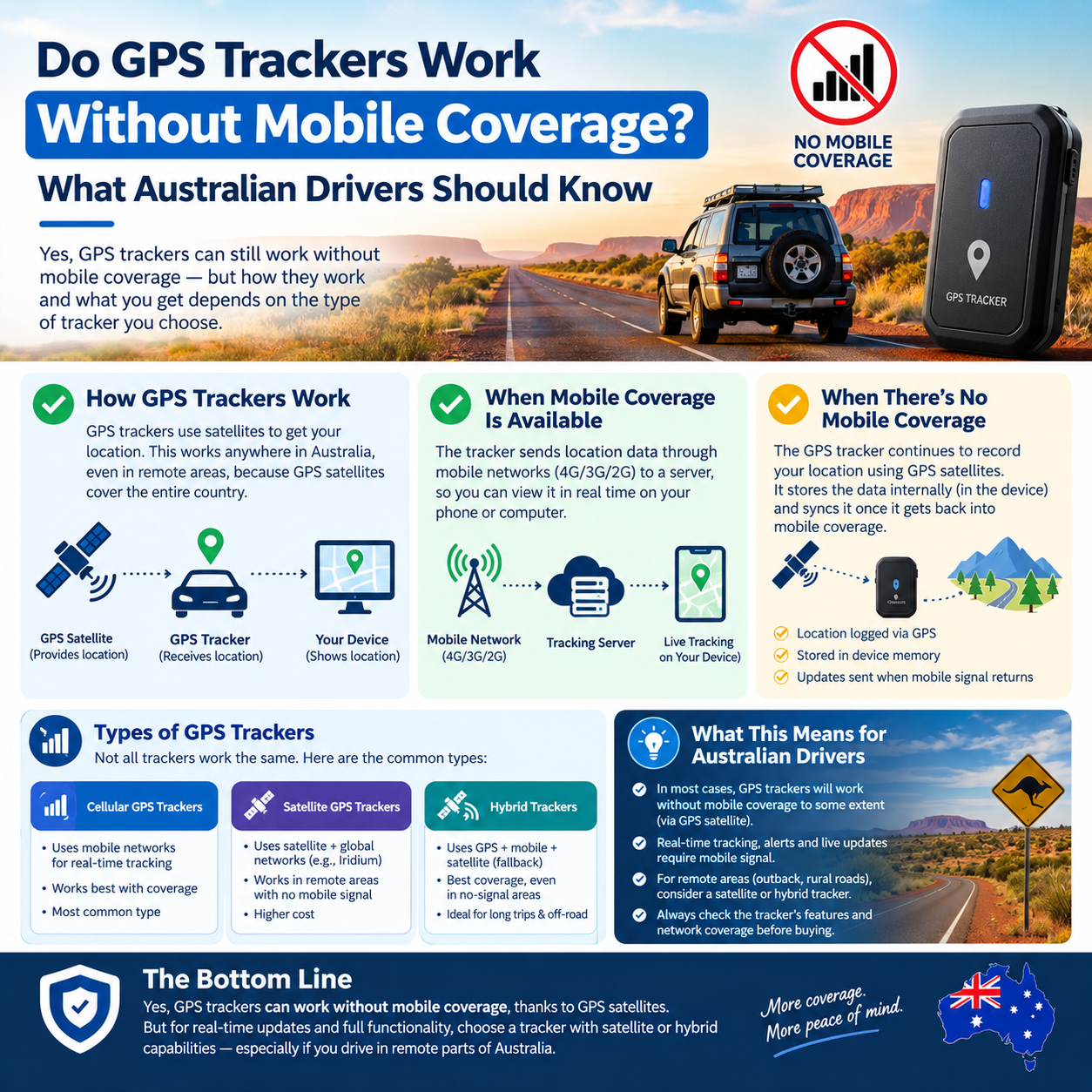
A GPS tracker generally uses satellites to determine its location. It calculates its position using signals received from GPS satellites.
However, knowing the location and transmitting it are two different processes.
Most vehicle GPS trackers use a mobile network, such as cellular connectivity, to send location data to an online platform or mobile app. If the tracker cannot connect to the network, live tracking may temporarily stop.
Some specialised tracking devices use satellite communication instead of mobile networks, allowing them to transmit data in areas where cellular coverage is unavailable.
What Happens When a GPS Tracker Loses Mobile Coverage?
When a vehicle travels into an area without mobile coverage, the tracker may continue recording its location, depending on its design and capabilities.
Here is what may happen:
- Location detection: The tracker may continue determining the vehicle’s position using GPS satellites.
- Live tracking: Real-time updates may become unavailable through the mobile app.
- Location storage: Some trackers save location history internally while offline.
- Data recovery: Trackers with offline storage may upload the recorded information once the network connection returns.
- Alerts: Notifications that require a mobile connection may be delayed or unavailable until connectivity is restored.
These features vary between devices, so it is important to check the specific tracker’s capabilities before purchasing one.
Can GPS Trackers Work in Remote Areas of Australia?
Australia has many remote regions where mobile coverage can be limited or unavailable. Drivers travelling through rural Queensland, Western Australia, the Northern Territory, and remote highway routes may encounter areas with weak connectivity.
A standard cellular GPS tracker may continue recording location data in these areas, but live updates could be interrupted.
For drivers who regularly travel through remote locations, a tracker with offline data storage or satellite communication may be more suitable.
The right option depends on how frequently the vehicle travels outside mobile coverage and whether real-time location updates are essential.
GPS Tracker vs Satellite Tracker: What Is the Difference?
Although both technologies can help track vehicles, they operate differently when it comes to communication.
| Feature | Cellular GPS Tracker | Satellite Tracking Device |
|---|---|---|
| Determines location | Uses GPS or other positioning systems | Uses GPS or other positioning systems |
| Sends location updates | Through a mobile network | Through satellite communication |
| Works outside mobile coverage | Live updates may be interrupted | Can transmit where satellite service is available |
| Typical use | Everyday cars, business fleets and urban travel | Remote travel, outback vehicles and specialised operations |
| Running costs | Often includes a mobile data or service plan | May involve a satellite service subscription |
A satellite tracker does not necessarily provide continuous updates everywhere. Performance depends on satellite visibility, device design, service coverage, and the selected subscription.
What Should You Look for in a GPS Tracker?
Before choosing a vehicle tracking device, consider the following features:
1. Offline location recording
Check whether the tracker can store location history when the mobile network is unavailable.
2. Automatic data uploads
Some devices automatically send stored information to the tracking platform after reconnecting.
3. Reliable network connectivity
Check which mobile networks and technologies the tracker supports, particularly if you travel outside major cities.
4. Satellite communication
If your vehicle regularly travels through areas without cellular coverage, consider a device designed to communicate through satellite networks.
5. Movement and security alerts
Depending on the model and available connectivity, a tracker may support alerts for unexpected movement, tampering, or other security events. Confirm which alerts work offline and which require a network connection.
6. Battery and power supply
Check how the tracker receives power and whether it has a backup battery. A backup battery can help during a power interruption, but it does not replace the need for communication coverage.
What Happens If Your Vehicle Is Stolen in an Area Without Coverage?
If a vehicle is stolen and enters an area without mobile coverage, a standard cellular tracker may not provide continuous live updates.
However, a device with offline recording may retain location information that can become available after the connection returns.
If tracking in remote areas is essential, consider a suitable satellite-enabled device before you need it. You should also keep your vehicle registration details and identifying information readily available and report a theft to the police as soon as possible.
Remember that a GPS tracker can support vehicle recovery, but it cannot guarantee that a stolen vehicle will be located or recovered.
Frequently Asked Questions
Does GPS work without mobile data?
Yes. GPS positioning does not normally require mobile data. However, a tracker usually needs a separate communication method to send its location to your phone or online tracking platform.
Will my GPS tracker show the live location without network coverage?
A standard cellular tracker may not provide live updates when it cannot connect to a mobile network. Some devices can continue recording locations for later transmission, while satellite-enabled trackers may offer communication beyond cellular coverage.
Will the tracker update its location after the signal returns?
It may do so if the device supports offline storage and automatic data uploads. Check the manufacturer’s specifications to confirm whether historical locations are saved.
Is a satellite tracker better for remote Australian travel?
It can be a better option if you need location reporting in areas without mobile coverage. However, costs, update frequency, satellite availability, and device capabilities should all be considered.
Do all GPS trackers have offline tracking?
No. Offline recording, internal storage, and automatic uploads are not available on every device. Always confirm these features before buying a tracker.
Final Thoughts
GPS trackers can still determine a vehicle’s location without mobile coverage, but that does not mean every tracker can transmit live updates in remote areas.
For everyday driving, a cellular GPS tracker with offline data storage may be sufficient. For regular travel through remote Australian regions, a satellite-enabled tracking device may be worth considering.
Understanding the difference between location detection and communication will help you choose a tracking solution that matches your vehicle, travel routes, and security requirements.