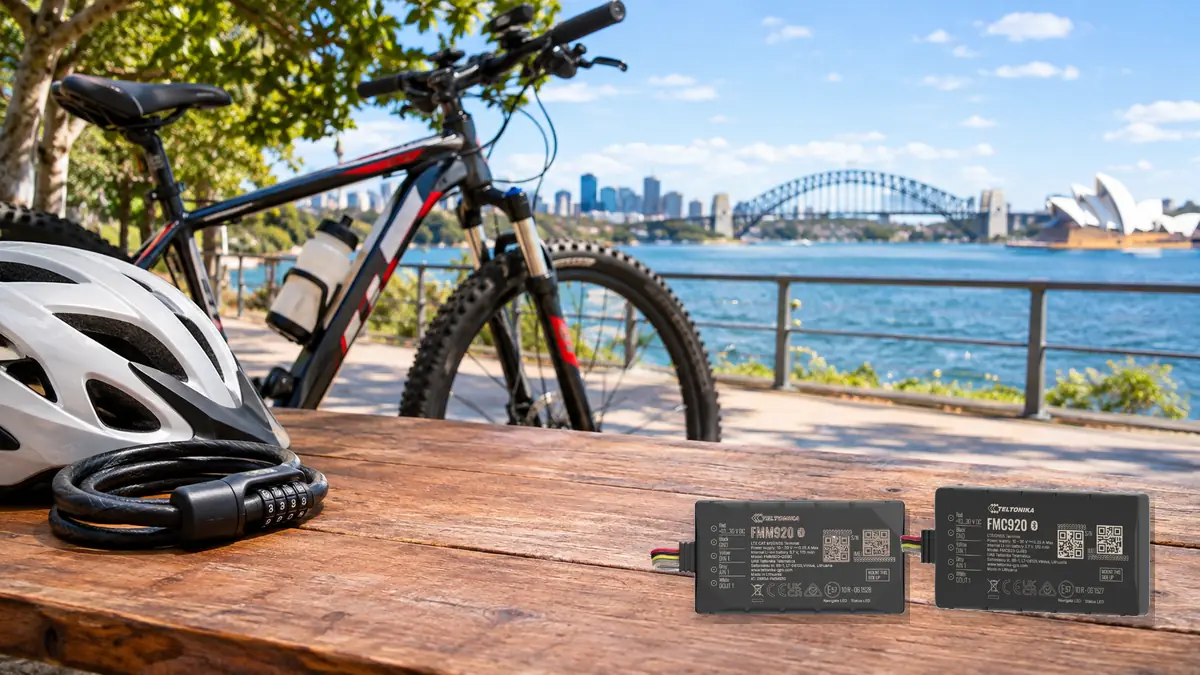
Keeping a bicycle secure is not always easy. Whether you park it outside your workplace, leave it at a railway station or store it in a shared residential area, knowing where your bicycle is can provide extra peace of mind.
A Bluetooth and Cellular Cycle Tracker offers two different approaches to bicycle location monitoring. Both technologies help users find their belongings, but they work in different ways.
Bluetooth trackers generally rely on nearby compatible devices or supported finding networks. Cellular GPS trackers use mobile networks to transmit location information over longer distances.
Understanding these differences can help cyclists choose a tracking solution that matches their budget, riding habits and security requirements.
In this guide, we explain how Bluetooth and cellular cycle trackers work, compare their features and discuss what to consider before buying one.
What Is a Bluetooth Cycle Tracker?
A Bluetooth cycle tracker is a compact electronic device that communicates with a nearby smartphone or another compatible device using Bluetooth technology.
It is commonly used to locate items within Bluetooth range. Some products also use a wider finding network, where participating smartphones can help report the approximate location of a missing tracker.
How Does a Bluetooth Cycle Tracker Work?
The process is relatively simple:
- Pair the tracker: Connect the device to a compatible smartphone using its supported application.
- Attach it to the bicycle: Install it in a suitable location or compatible accessory.
- Establish Bluetooth communication: The tracker communicates with nearby compatible devices.
- Check its location: Use the application to access the available location information.
- Use the finding network: If supported, participating devices may help report the tracker’s location when it is outside your phone’s Bluetooth range.
The availability and accuracy of remote finding depend on the product’s supported network, nearby participating devices and privacy settings.
Benefits of Bluetooth Cycle Trackers
Compact design: Many Bluetooth trackers are small enough to fit inside compatible bicycle accessories.
Lower ongoing costs: Some models do not require a separate cellular subscription.
Simple setup: Pairing with a compatible smartphone is usually straightforward.
Useful for nearby finding: Bluetooth can help users locate a bicycle or tracker when it is within communication range.
Low maintenance: Certain models use replaceable batteries that can last for extended periods, depending on usage.
Limitations of Bluetooth Trackers
Bluetooth trackers are not the same as independent GPS tracking devices.
- They generally have limited direct communication range.
- Remote finding may depend on a supported device network.
- They may not provide continuous location updates.
- They may not support independent live tracking.
- Their effectiveness can depend on nearby compatible devices.
What Is a Cellular Cycle Tracker?
A cellular cycle tracker is a device that uses mobile network connectivity to transmit location information to a connected application or tracking platform.
Many cellular bicycle trackers also include GPS or another satellite positioning system to calculate their geographical location.
Unlike a basic Bluetooth tracker, a cellular GPS tracker can communicate with a remote platform when it has suitable mobile network coverage.
How Does a Cellular Cycle Tracker Work?
A cellular GPS tracker generally follows these steps:
- Install the tracker: Mount the device securely on a compatible bicycle.
- Calculate its position: The GPS receiver obtains satellite signals and calculates geographical coordinates.
- Connect to a mobile network: The tracker uses a SIM card or embedded connectivity service.
- Transmit location information: The device sends available location data to a tracking platform.
- Monitor through an application: The bicycle owner can check reported locations using a compatible smartphone or computer.
GPS positioning and cellular communication perform different jobs. GPS helps determine where the bicycle is, while the cellular connection sends that information to the user.
Benefits of Cellular Cycle Trackers
Remote location monitoring: Cellular GPS models can transmit location information even when the owner is far away.
Regular location updates: Depending on the device, users may receive scheduled or event-based updates.
Movement notifications: Compatible trackers can alert users when unexpected movement occurs.
Geofencing: Some tracking platforms allow users to configure geographical boundaries and receive notifications when a tracker enters or leaves them.
Location history: Supported devices may store previous location records for later review.
Limitations of Cellular Trackers
Cellular trackers also have some limitations.
- They generally require a SIM card or embedded connectivity.
- A subscription or data plan may be necessary.
- Battery consumption depends on reporting frequency and network conditions.
- Cellular coverage is required for remote transmission.
- GPS positioning can be affected by buildings, tunnels and other obstructions.
- Not every vehicle GPS tracker is suitable for bicycle installation.
Bluetooth vs Cellular Cycle Tracker: Key Differences
Both technologies can support bicycle security, but their capabilities differ.
| Feature | Bluetooth Cycle Tracker | Cellular GPS Cycle Tracker |
| Main communication | Bluetooth | Mobile network |
| GPS positioning | Not necessarily included | Commonly included |
| Nearby finding | Yes, on compatible devices | Yes, depending on application |
| Remote location updates | Depends on finding network | Available with suitable connectivity |
| Live tracking | Generally not independent | Available on compatible models |
| SIM or data plan | Usually not required | Generally required |
| Movement alerts | Depends on model | Available on compatible models |
| Geofencing | Product-dependent | Available on compatible platforms |
| Battery requirements | Often relatively low | Depends on reporting and connectivity |
| Best suited for | Nearby item finding | Remote location monitoring |
The exact capabilities vary between manufacturers and products. Check the specifications rather than relying on the technology name alone.
Which Cycle Tracker Is Better for Your Needs?
The right option depends on how you use your bicycle.
Choose Bluetooth If You:
- Mainly need help finding a nearby bicycle.
- Want a compact tracking accessory.
- Prefer to avoid a separate cellular subscription.
- Are comfortable using a supported finding network.
- Do not require continuous remote location updates.
Choose Cellular GPS If You:
- Want to monitor your bicycle from another location.
- Need remote location updates.
- Want compatible movement notifications.
- Prefer access to location history.
- Need a tracking platform that supports geofencing.
A cellular GPS tracker may be more suitable for remote monitoring, while Bluetooth can be a practical option for nearby item finding.
Can a Cycle Tracker Use Both Bluetooth and Cellular Technology?
Yes. Some tracking devices combine multiple communication technologies.
A dual-technology tracker may use Bluetooth for nearby communication and cellular connectivity for remote location transmission.
Depending on its design, it may also include GPS positioning.
Potential benefits include:
- Nearby Bluetooth communication
- Remote cellular connectivity
- GPS-based geographical positioning
- Smartphone application access
- Multiple tracking options
However, not every tracker supports this combination. Confirm the manufacturer’s technical specifications before purchasing.
Important Features to Check Before Buying a Cycle Tracker
Whether you choose Bluetooth or cellular technology, consider these factors.
1. Tracking Range and Connectivity
Check the communication range of Bluetooth devices and the network requirements of cellular trackers.
For remote monitoring, confirm the supported cellular technology and coverage.
2. GPS Accuracy
If you choose a GPS-enabled tracker, review its positioning specifications.
Location accuracy can vary with satellite visibility, surroundings and device quality.
3. Battery Life
Battery performance depends on battery capacity, tracking frequency and communication methods.
Bluetooth trackers may use less power than some cellular GPS devices, but actual performance varies by product.
4. Waterproof Protection
Cycling trackers may be exposed to rain, dust and road spray.
Check the product’s IP rating and follow its water-exposure instructions. Water resistance does not automatically mean that a tracker is suitable for immersion.
5. Smartphone Compatibility
Confirm that the tracker supports your phone’s operating system and that its application is available in your region.
6. Movement Alerts
If bicycle security is your main concern, check whether the device supports movement detection and smartphone notifications.
7. Installation and Size
Choose a compact tracker that can be mounted securely without interfering with bicycle components.
8. Subscription Costs
Bluetooth trackers may have no separate cellular subscription, although some services can have optional fees.
Cellular GPS trackers generally require a suitable connectivity plan. Compare ongoing costs before making a purchase.
Are Bluetooth and Cellular Trackers Useful for Bicycle Theft Protection?
Both technologies can support bicycle security, but they offer different levels of location visibility.
A Bluetooth tracker may help identify a nearby bicycle or use a supported finding network to report its approximate location.
A cellular GPS tracker may provide remote location information through a connected tracking platform, provided that GPS positioning and network coverage are available.
Neither technology physically prevents theft or guarantees recovery.
For better protection, combine a suitable tracker with:
- A strong, quality bicycle lock.
- Secure bicycle parking.
- A recorded frame serial number.
- Photographs and proof of ownership.
- Movement alerts where supported.
How to Choose a Cycle Tracker in Australia
Before purchasing a cycle tracking device in Australia, check the following:
- Confirm whether the tracker uses Bluetooth, GPS or cellular connectivity.
- Check whether the device supports Australian mobile networks.
- Review its battery life and charging requirements.
- Compare the available mobile application features.
- Check its waterproof rating.
- Confirm the device’s mounting compatibility.
- Understand any subscription or data charges.
- Review the manufacturer’s warranty and support arrangements.
For cellular devices, pay particular attention to network compatibility. A device that depends on an unsupported or discontinued mobile network may not provide reliable service.
How Australia Fleet Tracking Can Help
Understanding the difference between Bluetooth and cellular tracking is important when choosing a suitable monitoring solution.
Australia Fleet Tracking provides GPS tracking products and information for vehicle and asset monitoring.
You can explore its Vehicle Tracking page to learn more about GPS-based vehicle monitoring.
Businesses looking to monitor valuable equipment can also explore Equipment and Asset GPS Tracking in Australia.
Before choosing a product for bicycle tracking, confirm its size, power requirements, connectivity options and mounting compatibility. Not every commercial vehicle GPS tracker is designed for bicycles.
Frequently Asked Questions
1. What is the difference between Bluetooth and cellular cycle trackers?
Bluetooth trackers communicate with nearby devices or supported finding networks. Cellular GPS trackers use mobile networks to transmit location information to a remote platform.
2. Can a Bluetooth cycle tracker work without the internet?
Bluetooth communication between nearby devices does not require an internet connection. However, remote finding through a supported device network may require internet access on participating devices.
3. Does a cellular cycle tracker need a SIM card?
Most cellular GPS trackers require a SIM card or embedded connectivity service to transmit location information.
4. Can a Bluetooth tracker show the live location of a stolen bicycle?
A standard Bluetooth tracker does not generally provide independent continuous GPS tracking. Some products can report location through supported finding networks when compatible devices detect them.
5. Is a cellular GPS tracker better for bicycle security?
A cellular GPS tracker may be more suitable when remote location monitoring is required. Its effectiveness depends on GPS positioning, cellular coverage, battery condition and device settings.
6. Can a cycle tracker use Bluetooth and GPS together?
Yes. Some products combine Bluetooth communication with GPS positioning. Certain models also include cellular connectivity for remote monitoring.
7. Which tracker has better battery life?
Bluetooth trackers often have lower power requirements, but battery life depends on the individual product. Cellular GPS trackers may use more power when sending frequent location updates.
8. Do cellular bicycle trackers work everywhere in Australia?
No. Remote tracking depends on supported network technology and mobile coverage. Check the provider’s coverage information before purchasing.
9. Can I install a cellular GPS tracker inside my bicycle frame?
Only if the bicycle and tracker manufacturers permit it. Metal structures can affect wireless signals, and the installation must not compromise bicycle safety.
Final Thoughts
Bluetooth and cellular cycle trackers offer different ways to locate and monitor a bicycle.
Bluetooth devices are useful for nearby item finding and may use supported finding networks to help locate missing belongings. Cellular GPS trackers are more suitable for remote location monitoring when network coverage is available.
Before choosing one, consider your tracking requirements, battery life, connectivity costs, waterproof protection and installation options.
The best cycle tracker is the one that provides the right features for your bicycle and everyday riding conditions.