The decision this article should help readers make
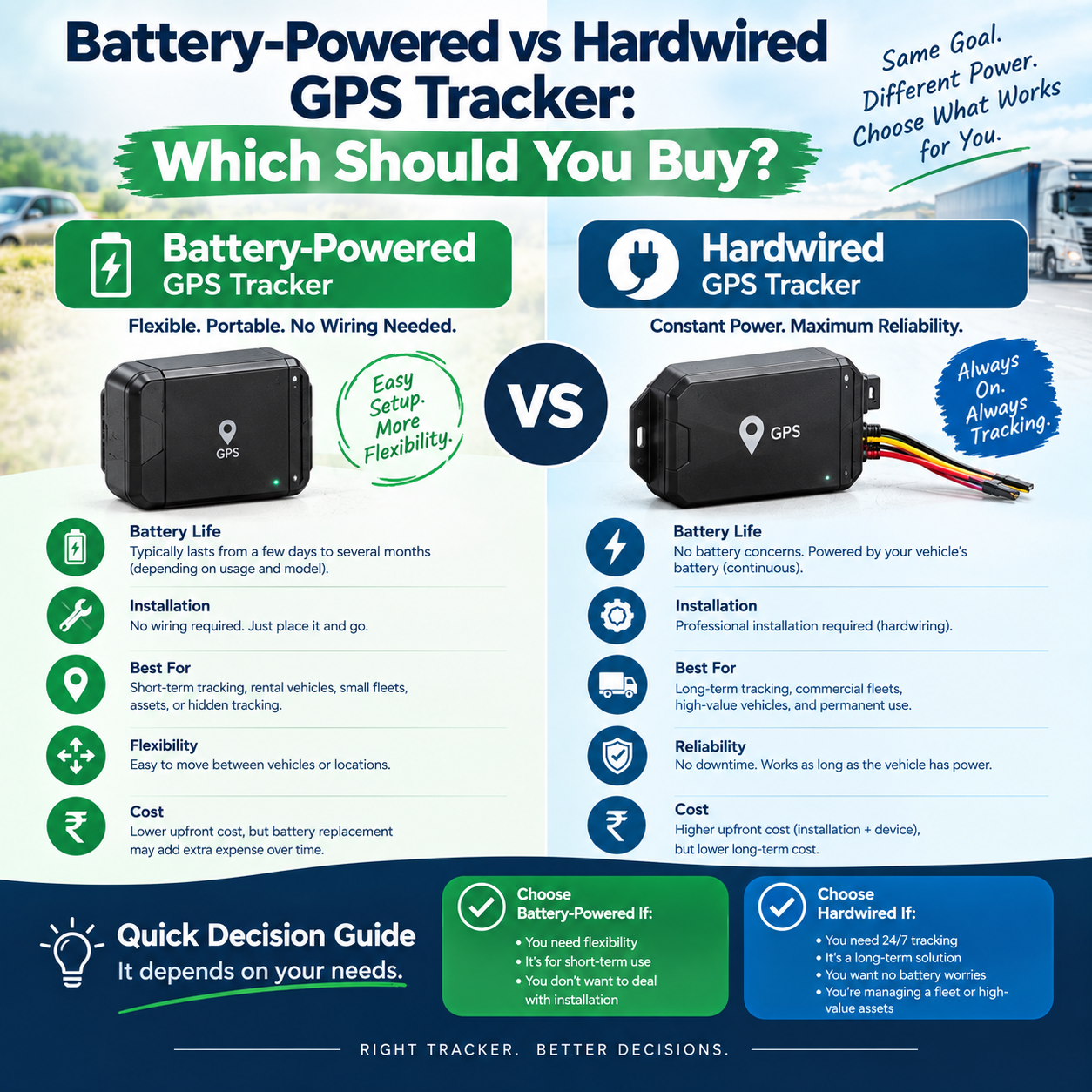
Battery-powered trackers suit trailers, portable equipment and assets without dependable vehicle power. Hardwired trackers suit vehicles that need frequent updates, ignition events and permanent installation. The choice is a trade-off between reporting frequency, service access, concealment and installation—not a universal ranking.
A useful implementation starts with the decision, then works backward to data, configuration and ownership. The platform should make limitations visible: last-update time, device health, asset assignment and the difference between an automated signal and a verified business event.
| Decision area | Evidence to use | Implementation rule |
| Hardwired | Cars, utes, vans and powered equipment used regularly | Supports frequent reporting and ignition-based trips. |
| Rechargeable battery | Portable or temporary assets | Requires a charging owner and documented interval. |
| Replaceable primary battery | Long-life low-frequency asset tracking | Battery life depends strongly on movement, signal and settings. |
| Solar-assisted | Outdoor assets with suitable exposure | Confirm charging assumptions and environmental rating. |
Build a reliable operating process
Treat the tracking platform as one part of the operating system. Job, maintenance, finance, safety and workforce records may be needed to interpret what the device reports. The following sequence creates a repeatable control rather than another set of notifications.
- Classify each asset by available power and mobility.
- Write the required live and parked reporting intervals.
- Model battery life using conservative conditions.
- Choose service access and inspection ownership.
- Test coverage, mounting and tamper scenarios.
- Configure low-battery and offline alerts before deployment.
Assign a named owner to each recurring report or alert and document what closes the item. Acknowledging a notification is not the same as resolving its underlying cause. Where data affects a worker, customer or legal decision, preserve source records and provide an appropriate correction or review process.
Common mistakes and how to avoid them
Most poor outcomes come from weak definitions and governance rather than inaccurate satellite positioning. Review these risks during the pilot and again after the first reporting cycle.
- Believing maximum battery-life marketing as a guarantee
- Using a hardwired vehicle tracker on an unpowered trailer
- Selecting rapid updates without accepting battery impact
- Mounting a battery unit where it cannot be serviced
- Ignoring heat, water and vibration ratings
Do not turn operational data into unsupported certainty. A vehicle near a site may not have completed the job; a diagnostic code may not identify the required repair; and an automated score may not fairly describe a driver. Use corroborating records and professional judgement.
Australian privacy, safety and compliance boundaries
Location history may identify workers, customers, homes and sensitive sites. Define the purpose, give required notices, limit collection, use named accounts and multi-factor authentication, restrict exports and apply a documented retention period. Workplace-surveillance and privacy requirements differ by jurisdiction and circumstance, so obtain advice for the actual operation.
For heavy vehicles, telematics can support monitoring and evidence within a Safety Management System, but it does not establish compliance by itself. Scheduling, alerts or performance targets must never pressure a driver to speed, skip maintenance, exceed work limits or operate while unfit to drive.
Record configuration changes, device-to-asset assignments and known outages. Those controls make operational reports more trustworthy and help a business explain what data could and could not show at a particular time.
Why battery-life claims vary
A battery device consumes energy when it wakes, obtains a GNSS fix, connects to the mobile network and transmits. More frequent movement, weak signal, cold or heat, poor antenna orientation and repeated connection attempts can shorten service life. Ask for the assumptions behind any estimate.
For a theft-sensitive asset, a very long sleep interval may preserve battery but delay awareness. Use different profiles for normal parked monitoring and movement events where the hardware supports them.
Whole-of-life service design
Count technician travel, access equipment, charging downtime and missed inspections. A lower-cost battery tracker mounted on a remote trailer can become expensive if it needs frequent attention. A safe power connection or solar-assisted unit may be better where the asset and operating environment support it.
Practical Australian example
A builder tracks six powered utes, four tool trailers and two portable generators. One device type would either waste installation capability or create excessive battery servicing.
Hardwired units serve the utes; weather-suitable battery trackers serve the trailers and generators with different movement and heartbeat profiles.
Low-battery alerts go to the person who schedules site service, not merely the business owner.
A 90-day implementation plan
- Days 1–15: define the business question, asset groups, baseline, users and legal requirements.
- Days 16–30: configure a pilot using representative vehicles, routes and difficult coverage or power conditions.
- Days 31–45: test timestamps, assignments, alerts, calculations, exports and failure states against source records.
- Days 46–60: issue notices, train managers and workers, establish owners and document correction and escalation paths.
- Days 61–75: deploy in controlled waves and reconcile every device, SIM and asset before accepting the installation.
- Days 76–90: compare results with the baseline, remove noisy controls and approve the next improvement cycle.
| Success test: A reader should be able to identify the next decision, the evidence required, the owner and the limitation of the GPS data. |
Questions to ask a tracking provider
- Which Australian mobile networks and radio technologies are supported, and how are coverage gaps shown?
- What update intervals, history retention, device-health alerts and exports are included?
- Can access be restricted by role, depot, vehicle group and report type?
- Which device, user, asset-assignment and configuration changes appear in the audit log?
- What are the hardware warranty, installation record, replacement process, support hours and exit costs?
- Which capabilities are rules, analytics or genuine AI, and can the supplier show the underlying evidence?
Ask for a demonstration using a realistic ordinary day and a failure case. The supplier should show a stale last-known point, an offline device, a corrected vehicle assignment and the workflow for closing an exception—not only a polished live map.
Frequently asked questions
How long does a battery tracker last?
It varies with battery capacity, update settings, movement, temperature, coverage and device design.
Is hardwired always more reliable?
It avoids routine charging but still depends on installation, vehicle battery, network and configuration.
Can a battery tracker update every few seconds?
Some can temporarily, but frequent transmission materially affects endurance.
What happens when the vehicle battery is disconnected?
Some hardwired units issue a power-loss event and use a small backup battery for a limited period.
Which is better for a trailer?
Usually a purpose-built battery or safely powered trailer solution, selected around service access and required alerts.
About Techtonika Autolink
Techtonika Autolink helps Australian businesses choose, install and configure GPS tracking for vehicles and mobile assets. For practical advice on hardware, professional installation and platform setup, visit https://techtonika-autolink.com/ or call 0452 653 745.