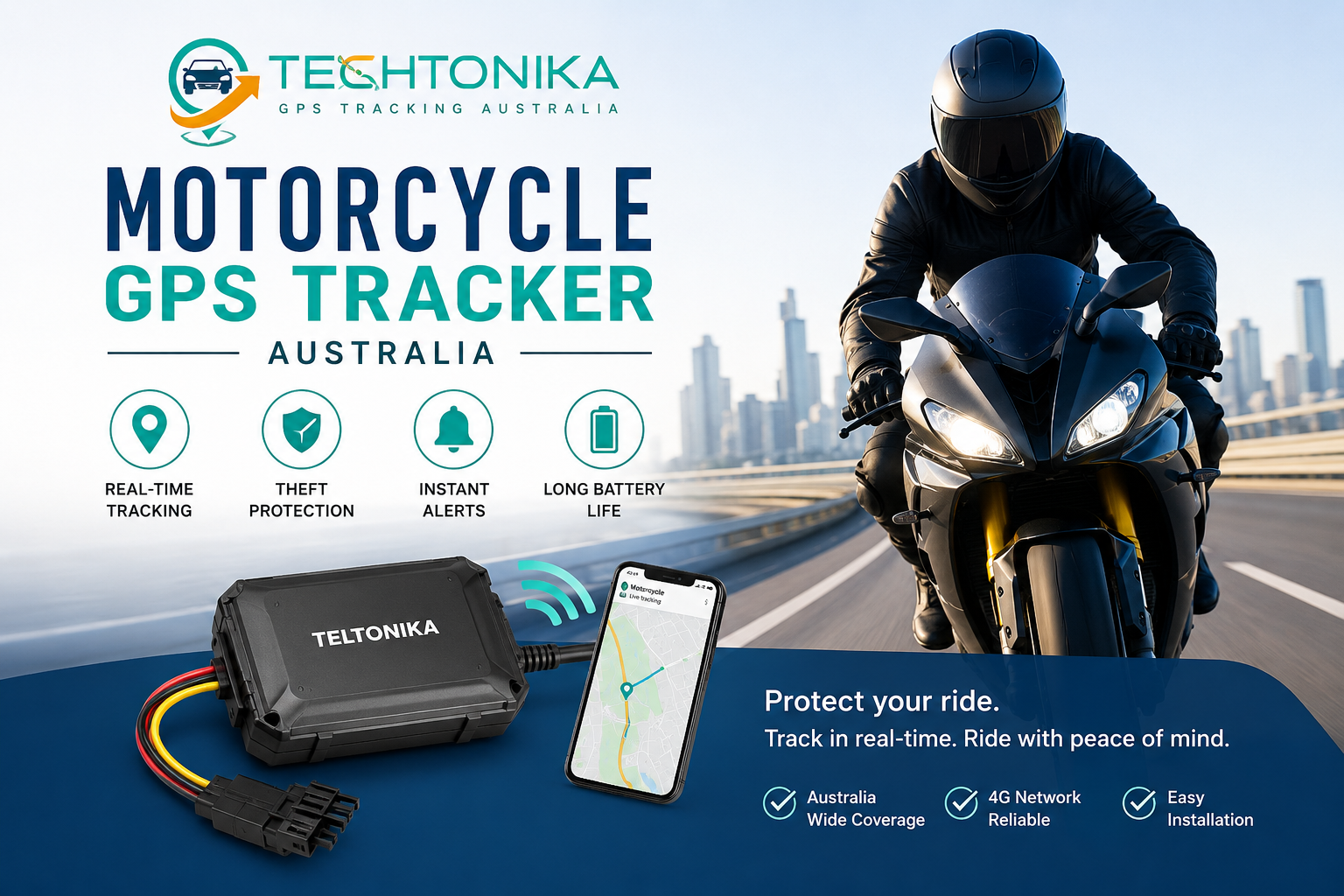
Choose a compact 4G device with movement alerts, appropriate weather and vibration resistance, secure concealed mounting and power consumption suited to the battery. For machines without dependable power, use a purpose-built battery asset tracker. This guide is for motorcycle GPS tracker Australia riders, farms and recreational ATV or quad-bike owners. It focuses on the practical buying and operating decisions that determine whether tracking remains reliable after the initial installation.
At-a-glance recommendation
| Situation | Recommended starting point | Why |
| Road motorcycle | Compact hardwired tracker | Permanent power and concealed installation |
| Farm quad bike | Rugged battery or hardwired | Dust, vibration and regional use |
| Stored recreational ATV | Battery tracker | Independent power during storage |
| Motorcycle fleet | Hardwired multi-device platform | Trips, security and maintenance records |
Small batteries and limited space
Motorcycle batteries have less reserve capacity than many cars.
Start by translating this point into a testable requirement. Specify the asset, expected event, acceptable reporting delay and person responsible for responding. This prevents the buying decision from being reduced to a list of attractive but unused features.
The tracker must sleep efficiently and avoid constant high-frequency reporting while parked.
Use representative vehicles, locations and operating hours during a trial. Performance on a desk or in a metropolitan car park may not represent storage yards, regional roads, steel structures or long periods without power.
Physical size, antenna orientation and heat exposure constrain placement.
Document the selected configuration and review it after the first month. Reporting intervals, alert thresholds and permissions often need refinement once real movement patterns become visible.
Weather, dust and vibration
Motorcycles and ATVs experience water, mud, vibration and temperature extremes.
Start by translating this point into a testable requirement. Specify the asset, expected event, acceptable reporting delay and person responsible for responding. This prevents the buying decision from being reduced to a list of attractive but unused features.
Select a suitable enclosure rating and mount mechanically, not only with adhesive.
Use representative vehicles, locations and operating hours during a trial. Performance on a desk or in a metropolitan car park may not represent storage yards, regional roads, steel structures or long periods without power.
Inspect after rough use and scheduled maintenance.
Document the selected configuration and review it after the first month. Reporting intervals, alert thresholds and permissions often need refinement once real movement patterns become visible.
Hardwired versus battery
Hardwired devices suit frequently used machines and eliminate charging.
Start by translating this point into a testable requirement. Specify the asset, expected event, acceptable reporting delay and person responsible for responding. This prevents the buying decision from being reduced to a list of attractive but unused features.
Battery trackers suit seasonal equipment or machines with unsuitable electrical systems.
Use representative vehicles, locations and operating hours during a trial. Performance on a desk or in a metropolitan car park may not represent storage yards, regional roads, steel structures or long periods without power.
The expected movement pattern determines real battery life.
Document the selected configuration and review it after the first month. Reporting intervals, alert thresholds and permissions often need refinement once real movement patterns become visible.
Theft alerts
Movement, tilt, tow and geofence alerts can provide early warning.
Start by translating this point into a testable requirement. Specify the asset, expected event, acceptable reporting delay and person responsible for responding. This prevents the buying decision from being reduced to a list of attractive but unused features.
False alarms should be reduced through thresholds and schedules.
Use representative vehicles, locations and operating hours during a trial. Performance on a desk or in a metropolitan car park may not represent storage yards, regional roads, steel structures or long periods without power.
Tracking supports recovery but does not replace locks and secure storage.
Document the selected configuration and review it after the first month. Reporting intervals, alert thresholds and permissions often need refinement once real movement patterns become visible.
Regional and farm coverage
A tracker can receive satellites while lacking mobile service.
Start by translating this point into a testable requirement. Specify the asset, expected event, acceptable reporting delay and person responsible for responding. This prevents the buying decision from being reduced to a list of attractive but unused features.
Offline storage preserves history when configured, but alerts wait for reconnection.
Use representative vehicles, locations and operating hours during a trial. Performance on a desk or in a metropolitan car park may not represent storage yards, regional roads, steel structures or long periods without power.
Review actual coverage around farms, trails and transport routes.
Document the selected configuration and review it after the first month. Reporting intervals, alert thresholds and permissions often need refinement once real movement patterns become visible.
Safe installation
Keep devices away from exhaust heat, steering travel, suspension, chains and fuel components.
Start by translating this point into a testable requirement. Specify the asset, expected event, acceptable reporting delay and person responsible for responding. This prevents the buying decision from being reduced to a list of attractive but unused features.
Do not compromise waterproof connectors or factory wiring.
Use representative vehicles, locations and operating hours during a trial. Performance on a desk or in a metropolitan car park may not represent storage yards, regional roads, steel structures or long periods without power.
Test signal, charging voltage and alerts after installation.
Document the selected configuration and review it after the first month. Reporting intervals, alert thresholds and permissions often need refinement once real movement patterns become visible.
Australian network requirements in 2026
Australia’s 3G networks have closed, so new installations should use compatible 4G hardware and service. Check the exact modem technology, frequency bands, SIM arrangement and carrier coverage; a generic 4G label does not guarantee compatibility.
GPS satellite reception and mobile coverage are separate. A tracker may calculate and store positions when it cannot transmit them. Quality devices can forward buffered records after reconnection, but live alerts normally wait for communication to return. ACMA’s standardised coverage information helps comparison, while terrain, buildings and installation still affect real performance.
Installation and commissioning checklist
- Confirm device model, SIM activation and platform assignment.
- Choose a dry, secure and radio-friendly location.
- Verify power, sleep behaviour and backup battery where applicable.
- Drive or move the asset through a representative test.
- Trigger the important movement, geofence, power and battery alerts.
- Check the timestamp and offline-reconnection behaviour.
- Record the device identity, asset, installer and authorised users.
Common mistakes to avoid
- Using a car-sized device in a cramped hot space.
- Ignoring parked battery drain.
- Mounting with weak adhesive on a high-vibration ATV.
- Expecting live coverage across every farm.
- Placing near steering, chains or exhaust.
Cost and buying checklist
Compare the complete first-year and ongoing cost: hardware, mobile connectivity, platform subscription, installation, accessories, support, warranty and replacement. Battery-powered deployments must also include charging or inspection labour. A low purchase price is poor value if the device is incompatible, difficult to manage or unsupported.
- Current Australian-compatible 4G connectivity.
- Power strategy matched to the asset.
- Useful offline memory and later upload.
- Clear app, history and alert controls.
- Appropriate weather, voltage and vibration specifications.
- Local support across hardware, SIM, platform and installation.
Privacy and responsible use
Use tracking only with legitimate authority and a clear purpose. Workplace, surveillance and privacy requirements vary across Australia. The OAIC advises employers to comply with relevant Australian, state and territory laws. Tell affected workers what is collected, when, why, who can access it and how long it is retained, and seek advice for the actual jurisdiction and circumstances.
Restrict user access, review accounts and remove former staff promptly. Tracking data can reveal personal routines and sensitive locations, so it should not be collected or retained simply because the platform makes it possible. This article provides general information, not legal advice.
Recommended internal links
- Magnetic GPS Tracker vs Hardwired
- Do GPS Trackers Work Without Internet?
- GPS Tracker Installation Guide
- GPS Tracker for Motorcycles, ATVs and Quad Bikes in Australia product or service category
A practical 30-day evaluation plan
During the first week, confirm the fundamentals rather than changing advanced settings. Check that every asset appears under the correct name, positions carry current timestamps, trips start and finish as expected, and the responsible person receives the essential alerts. Record any coverage gaps and compare them with the actual route or storage environment.
In weeks two and three, review patterns instead of isolated points. Look for repeated alert noise, unusually long communication gaps, incorrect ignition behaviour, weak battery performance or user-access problems. Adjust one setting at a time and keep a simple change log so improvements can be traced to a specific configuration change.
At the end of 30 days, assess whether the system achieved the original purpose. Security users should check alert speed, battery readiness and the response process. Commercial users should review dispatch calls, kilometres, attendance evidence, asset searches, utilisation or maintenance actions relevant to the business case.
A successful trial ends with a documented standard for future installations: approved device, mounting approach, reporting profile, alert recipients, user permissions and commissioning tests. This turns a one-off installation into a repeatable tracking program and reduces support problems as more vehicles or assets are added.
Frequently asked questions
Can a tracker fit under a motorcycle seat?
Often, but heat, metal shielding, space and antenna orientation must be tested.
Confirm the result for the selected hardware, service plan and operating location because product configuration and coverage affect performance.
Will it drain the bike battery?
A suitable low-power configuration reduces risk; battery size and storage time still matter.
Confirm the result for the selected hardware, service plan and operating location because product configuration and coverage affect performance.
Is waterproofing essential?
It is important where the device or connections may be exposed.
Confirm the result for the selected hardware, service plan and operating location because product configuration and coverage affect performance.
Can it track an ATV without a battery?
Use a self-powered asset tracker.
Confirm the result for the selected hardware, service plan and operating location because product configuration and coverage affect performance.
Will it work on trails?
GPS may work with sky view, while live updates depend on mobile coverage.
Confirm the result for the selected hardware, service plan and operating location because product configuration and coverage affect performance.
Can it alert me if the bike is moved?
Yes, through movement or geofence alerts when supported and connected.
Confirm the result for the selected hardware, service plan and operating location because product configuration and coverage affect performance.
Get help choosing the right tracker
Australia Fleet Tracking supplies GPS and telematics solutions for cars, fleets, trucks, trailers and assets, including Teltonika hardwired, OBD and battery-powered devices. Professional installation and local support are available.
Visit https://australiafleettracking.com/, call 0452 653 745 or email info@techtonika-autolink.com for device and installation advice.
Sources and editorial references
- Australian Communications and Media Authority — 3G network switch off: https://www.acma.gov.au/3g-network-switch
- ACMA — New telco transparency rules now in force (30 June 2026): https://www.acma.gov.au/articles/2026-06/new-telco-transparency-rules-now-force
- Geoscience Australia — Positioning and navigation: https://www.ga.gov.au/scientific-topics/positioning-navigation
- OAIC — Workplace monitoring and surveillance: https://www.oaic.gov.au/privacy/your-privacy-rights/surveillance-and-monitoring/workplace-monitoring-and-surveillance
- Australia Fleet Tracking: https://australiafleettracking.com/
Techtonika Autolink
Follow Us
Facebook: https://www.facebook.com/profile.php?id=61591321884124
Instagram: https://www.instagram.com/techtonikaautolink/
LinkedIn: https://au.linkedin.com/company/techtonika-autolink
Unit 507, 15 Chatham Rd West, Ryde NSW 2114